electronic marketplaces
Electronic Marketplaces
Digitisation is playing an ever more present role in energy trading. Electronic marketplaces in particular are bringing together new assets and...
Why monolithic software architecture drains engineering budgets, and how modular data plumbing gives energy trading desks a practical commercial edge.
Not long ago, software updates meant flash drives, loading screens and the occasional, but infuriating error message. Today they typically happen silently overnight.
Similarly, if you decide to rearrange your TV’s menu, customize your phone's homescreen or try out a new AI tool, it’s just as smooth: you can simply download new apps, discard the old ones, and keep moving.
Yet, when you log into a typical energy trading desk, you step straight back into a rigid, hardcoded architecture.
A large portion of European utilities and trading departments run their entire power and gas books on software setups that operate like outdated feature phones. Every component is welded to the next. The market data feed, the risk calculation engine, the user interface, and the exchange connectors live inside a single, closed box.
When a primary venue updates its underlying infrastructure, this tightly bound engineering cracks.
The immediate threat of monolithic architecture becomes obvious during major venue transitions. The upcoming migration of the EEX natural gas spot market to the M7G trading engine is a perfect example. For a desk tied to a rigid vendor box, an exchange overhaul is a forced development project that puts your entire front-office workflow on hold.
Because the connectivity layer is buried deep inside the vendor's core code, you cannot simply update the specific exchange connector. Your development team has to spend weeks rewriting integration lines across your entire risk, finance, and front-end suite just to maintain the status quo.
While your developers are stuck in scoping meetings or waiting in a multi-month vendor queue, the market does not wait for them to turn their focus back.
As we saw in the latest exchange volume data, liquidity is no longer sitting quietly in traditional flagship hubs. Volume is fracturing into regional nodes at a staggering pace. Nordic power futures, Czech gas, and Italian spot markets are experiencing massive, sudden activity spikes.
If your software requires a custom engineering project every time a peripheral venue gains traction or changes its API, you face an unsustainable deployment lag. The early-mover spreads normalize before your new data pipe even goes live. A rigid architecture functions as a direct braking mechanism on your commercial margin.
Managing a volatile, decentralized energy landscape requires a complete separation of concerns within your technology stack. Your data plumbing must isolate venue connectivity from your proprietary trading logic and internal risk engines.
This is the baseline principle of modular infrastructure.
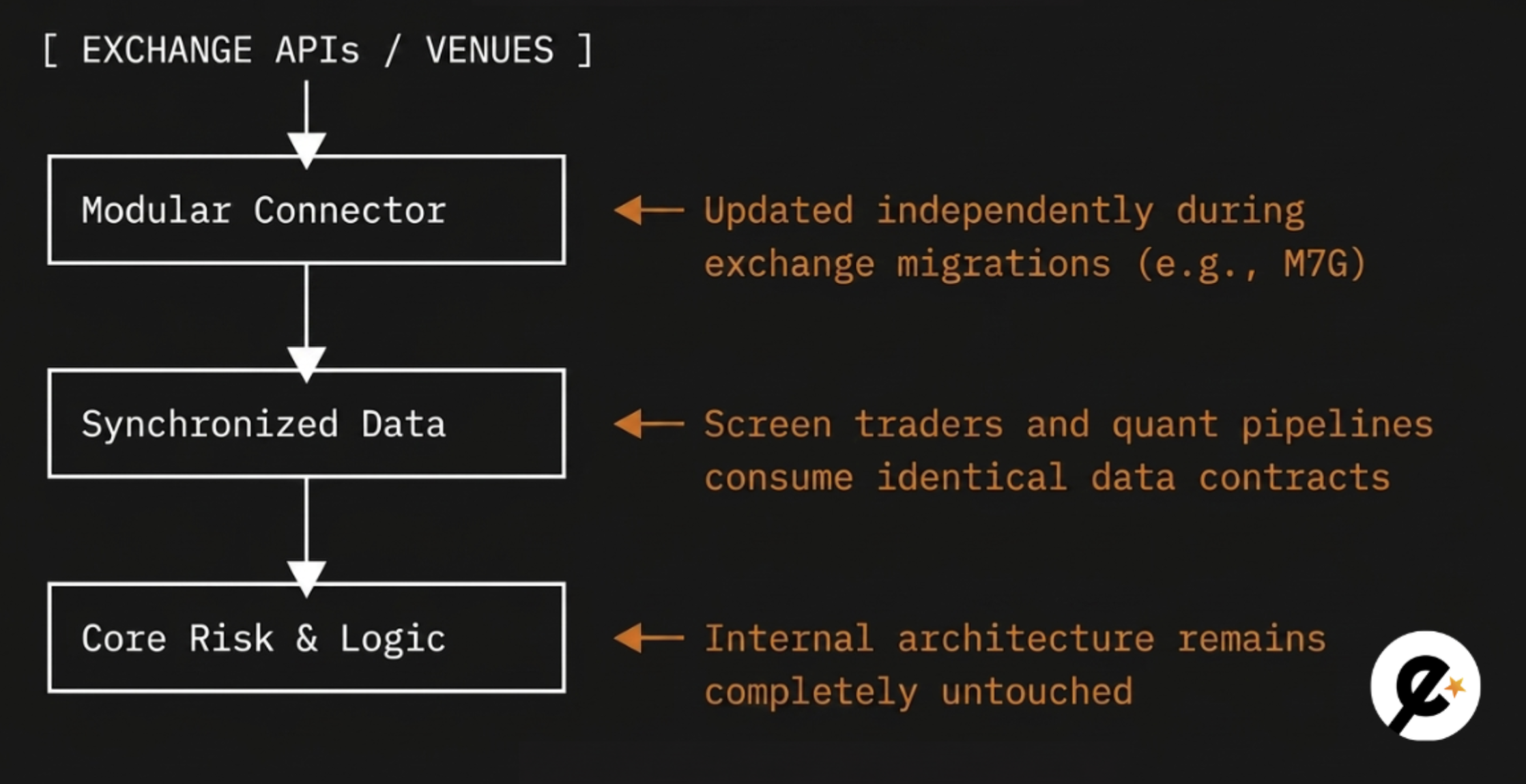
When an exchange modifies its protocol, you alter the specific connector module responsible for that venue. Your core database, your automated pipelines, and your execution screens remain entirely untouched. The engineering shock wave terminates at the boundary of the market interface.
This decoupled layout solves the synchronization problem that plagues traditional front offices. Instead of running separate, fragmented software packages for manual screen execution and automated algorithmic pipelines, every component consumes the exact same data contracts simultaneously. You get a single, clear view of positions and risk without paying multiple data licensing premiums for the same underlying order book.
Every time an exchange overhauls its engine, IT departments look at the upcoming migration as an unavoidable compliance tax. You have to reallocate development hours to rewrite your market connectivity layer anyway.
But this engineering obligation is also a massive commercial opening.
The switching costs to walk away from a rigid, closed vendor ecosystem drop significantly when you are forced to rebuild the connection regardless. The real choice becomes a strategic one: you can plug that fresh market connector straight back into another closed, monolithic box, or you can seize the window to establish an open foundation.
The desks capturing the spread in a shifting market are the ones that treat infrastructure agility as a commercial asset. If your system handles new connections as a simple modular plug rather than a major software release, you can wire up a new venue and deploy your strategies before the market catches up.
Digitisation is playing an ever more present role in energy trading. Electronic marketplaces in particular are bringing together new assets and...
What happens when liquidity dries up in forward energy markets? Without enough participants trading actively, price signals become distorted, hedging...
We describe what sets Golang apart from other programming languages and why it's satisfying the Energy Industry’s need for speed
What can we do for you?
Write us and learn about the scalability of our SaaS technology.We are looking forward to your challenge.